
Just bought these for my red couch… inspired by Joan Miró and Wassily Kandinsky.
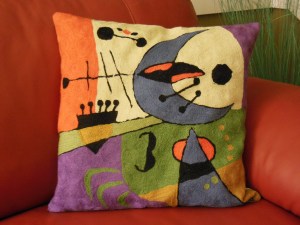
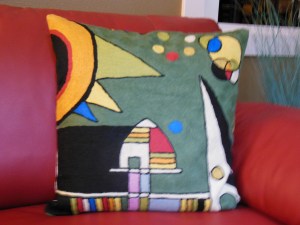
Just bought these for my red couch… inspired by Joan Miró and Wassily Kandinsky.
How can artists make anything ugly at all? you wonder;
just a black mark on thick white paper is so beautiful.
from Paris to the Moon, by Adam Gopnik
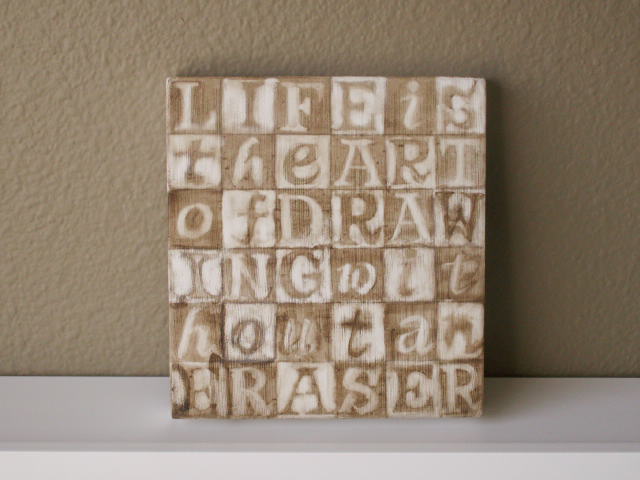
Life is the art of drawing without an eraser.
John W. Gardner, 1912-2002
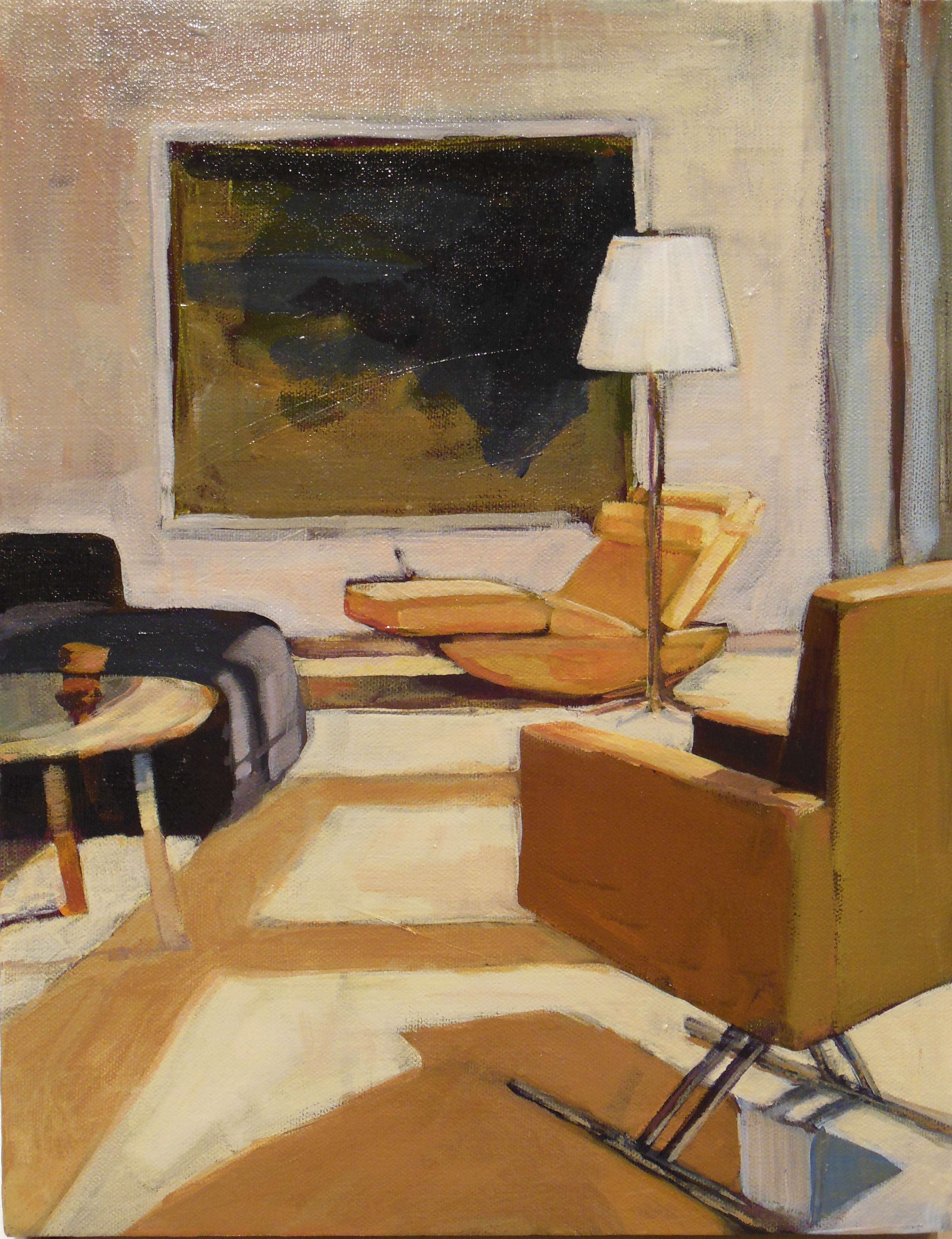
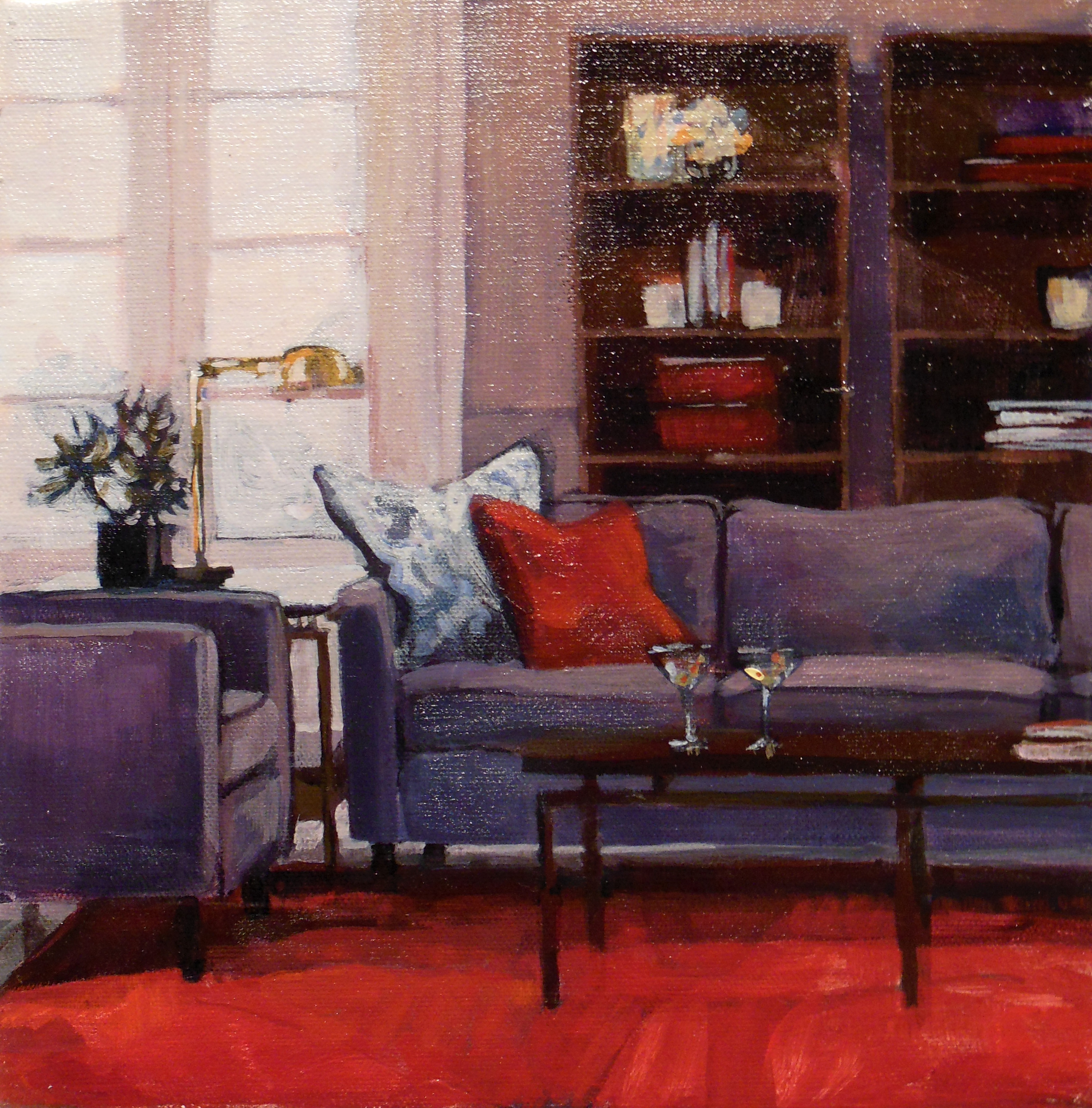
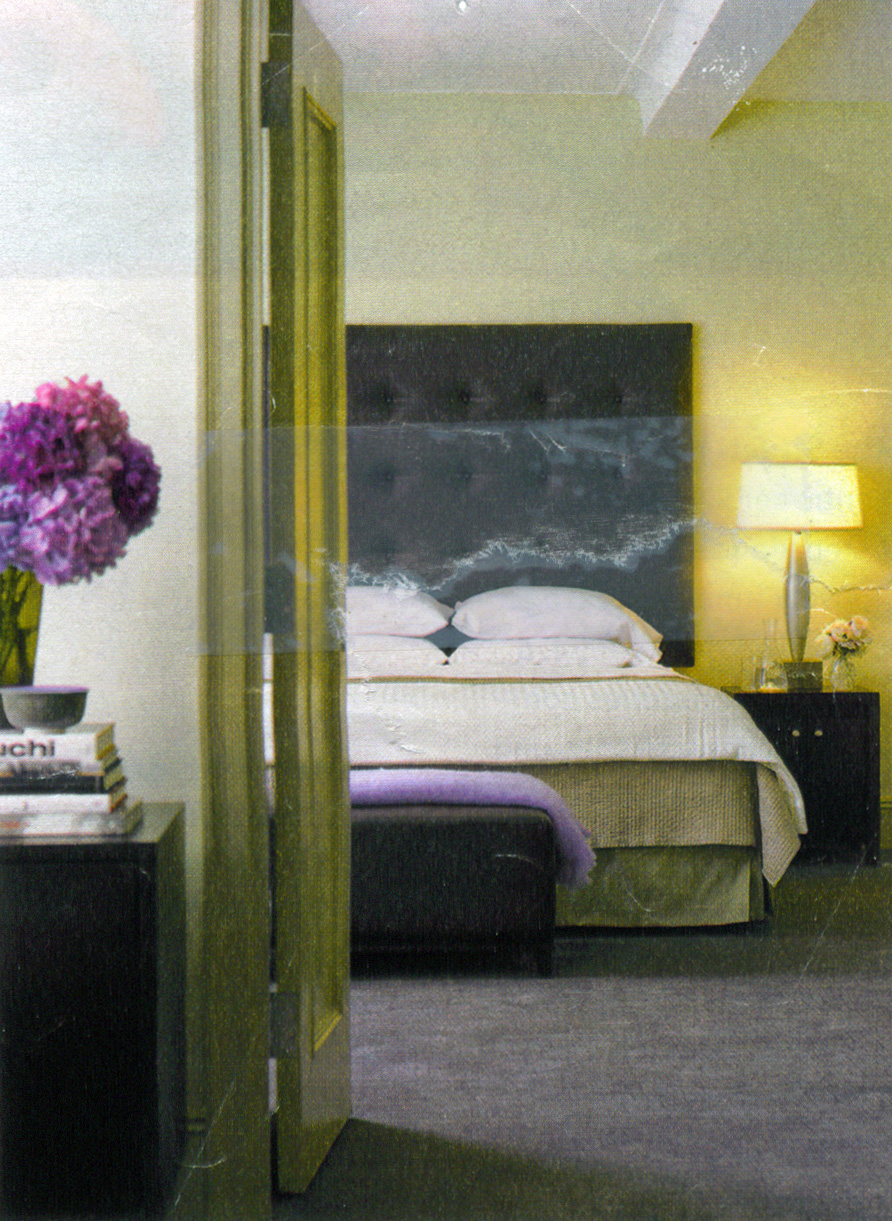
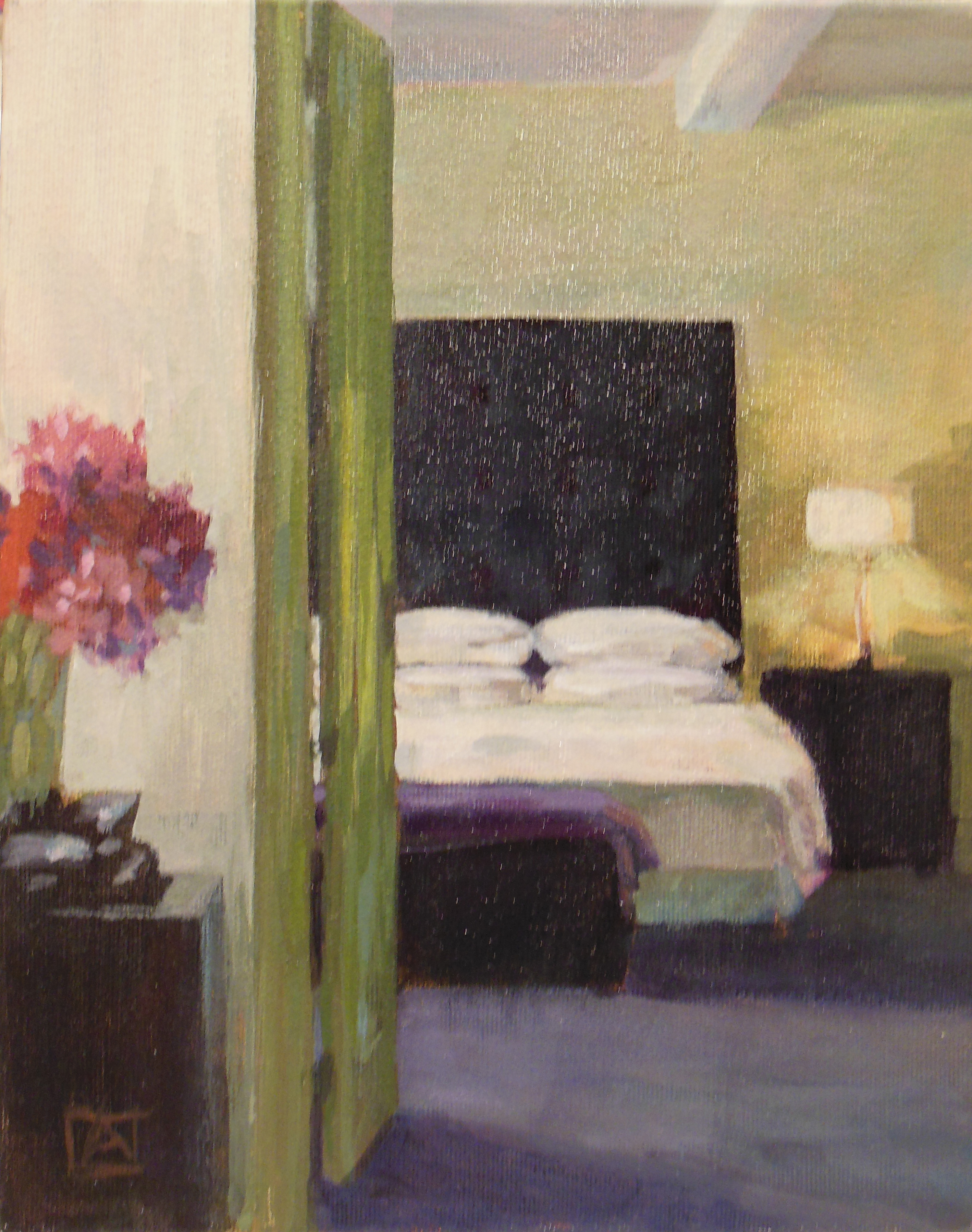
These are a series of paintings inspired by photographs cut out from magazines. All are in acrylics. Note too that the colors may not be as true as reality because of the photography and scanning.
The idea of the painting exercise is to substantially abstract the original inspiration by blocking in the main color shapes rather than drawing the subject first, paying attention to the composition, mixing the right colors. But then I tend to continue on with the details.
Though I was inspired by the photo and clearly used it as a reference, all along this was to teach myself more about how to paint, not to make an exact copy. You’ll see. Next time I start one of these, I’ll take photos of the progress.
On the left is the photo from The Sunday New York Times. On the right is my painting (11×14). Believe me, it started really loosely–just large shapes. I was pleased with some bits right away and knew not to touch them again–like the end table on the left and the painting on the back wall.
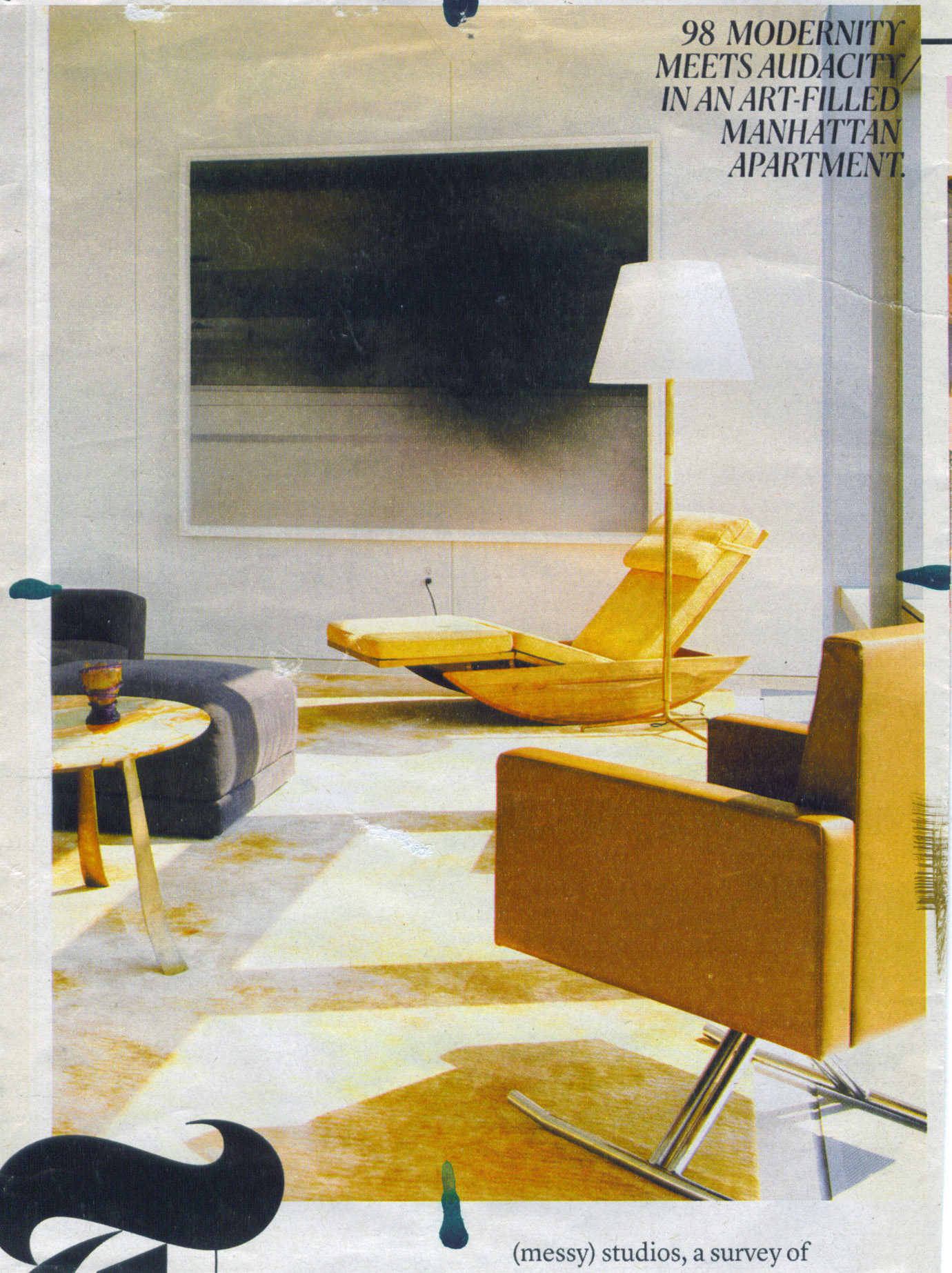
From an interior design magazine, probably Architectural Digest. My painting is 10×10.

And from another magazine, original photo on the left and my painting on the right (8×10). Hmmm, not bad composing. Honestly, I didn’t trace it.
And from a May 1999 issue of Bon Appetit magazine… the photo is on the left and my painting on the right (11×14). I can paint people but chose to emphasize the interior without the handsome chef.
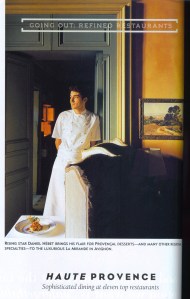
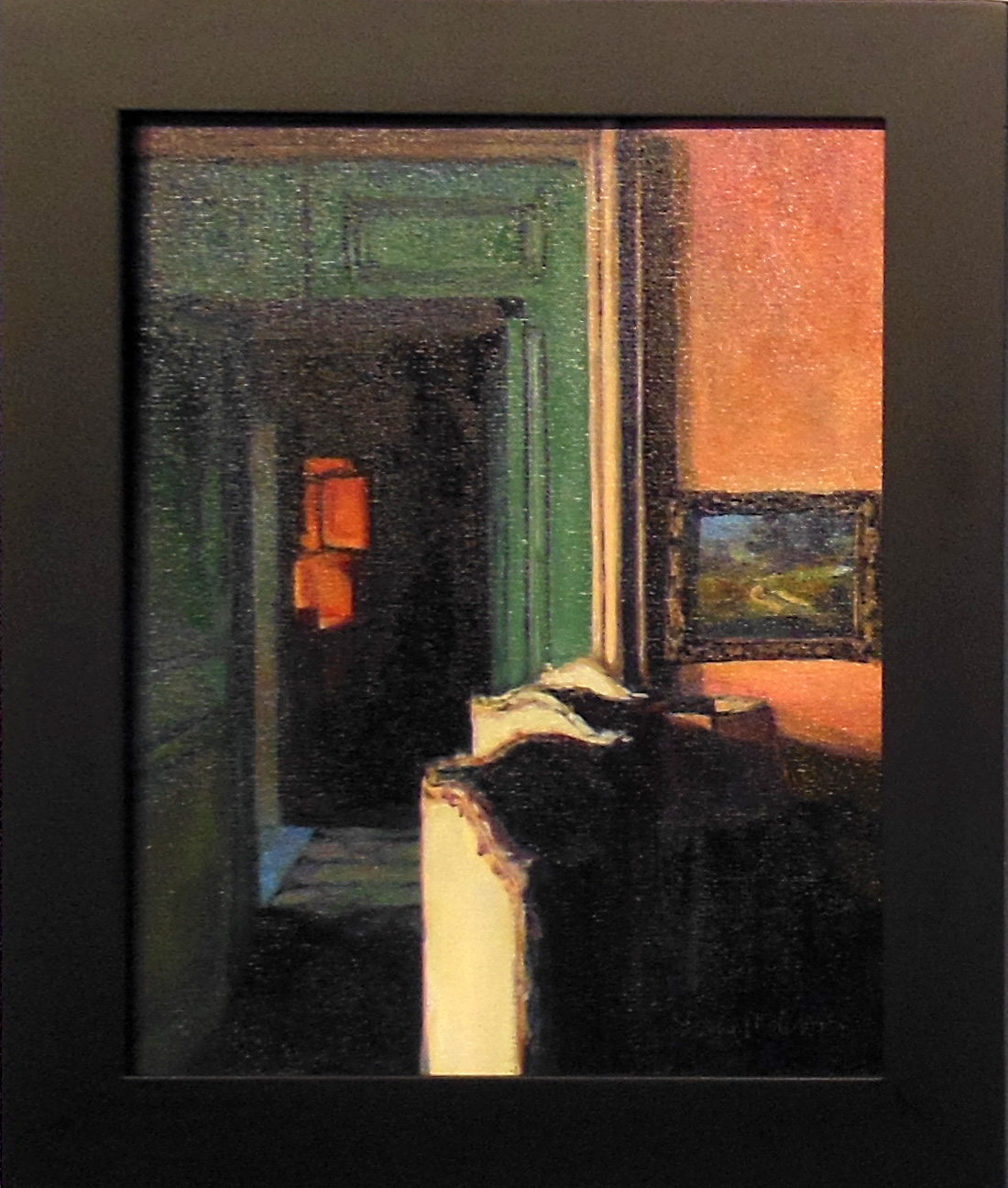
I gave my mom an Edward Gorey datebook that has tear-out postcards. She sent me this one and wrote on the back how fun it would be to read the mystery. Of course, Mr. Gorey made it all up so there isn’t one. Till now.
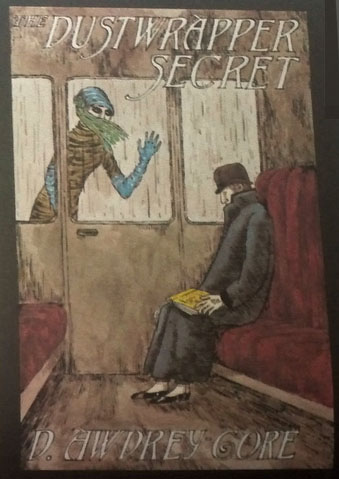
The Dustwrapper Secret
Chapter I: The Only Chapter
Just as her perfect bow of a mouth drew in a considerable gulp of air—“Oh!”—the draft from the corridor blew her turquoise silk scarf in with it. She found she had no breath to spat it out. Her kohl-ringed eyes were wide with the shock at seeing the bowler-hatted gentleman dozing in the next compartment. She braced herself with a matching turquoise silk-gloved hand on the smudged glass, then wondered at the suddenness of a desire to reach through it to touch him.
Could it be, she thought, is this my husband? The gentleman’s chin was sunk into the thickness of a raised collar and his forehead obscured by dark brown felt. She gazed intently at what was visible—the nose, the clean-shaven cheeks. Her mind raced as she worked equally hard to tear the scarf out of her mouth. Oh, dear, there’s lipstick on it now, she paused to note. The gentleman slept on, oblivious of the turmoil in the corridor, all stillness, a book balanced under a gloved hand on his knee.
Ah, what’s this he’s reading? She squinted at the up-side-down text. I should try harder to remember what my husband likes. But the lettering was caught in the glare of the overhead lamp and she could not tease it out. Ah, another clue, she smiled. He has on those lovely Italian slippers, as though he has just come from a dance. And with white-kid spats. He must have been out all night, she decided, satisfied, and that is why he is sleeping now. But, she frowned, how strange to be wearing an ordinary, though quite nicely-tailored, charcoal grey wool overcoat with black velvet cuffs and collar. And, her frown intensifying, did her husband go to dances anymore? She certainly did and she thought she had gone to one the night before and that she had not seen him there. She knit her brows. More proof would be to know what this gentleman is wearing underneath. Then she flushed at her temerity and the scarf sensibly stuck itself to the rosy glow upon her cheeks. She had never before wondered what her husband wore underneath. Something very sensible and hardly fashionable. She forced her attention to the gentleman’s bowler. She blew the scarf away and admitted that her comprehension of hats was only of the feminine variety. Did her husband even have a bowler? Or was it a trilby? Surely not a deerstalker. Well, she thought, growing impatient at the effort to swat away so many questions, I do know he has a top hat. And that it is not resting there upon the red velvet cushion.
She sighed. She went back to the nose. The shape, the color, the texture—all quite similar to her husband’s. She watched as the gentleman’s nostrils flared ever so slightly with each breath. Do my husband’s flare in quite the same way? She cocked her head. Ah ha! I do not see a moustache! But, if I remember correctly, my husband has one. She blinked at a wild thought. Surely my husband doesn’t put on and off a moustache like I put on and off rouge. She was pretty certain the last time she saw him, he had his on. And she had never seen it off on his bedside table.
Yet, there is something about this gentleman. Who is like my husband and not like my husband. Who has no idea I’m off to town on the train, which is like my husband. And who is going the same direction I am going, which is not like my husband. Who has a fine long nose, which is like my husband. Who is missing his moustache, which is not like my husband. Who is dozing over a book, which is like my husband. Who is reading—“Oh!”—she could see it perfectly now: the portrait photograph on the back of the dustwrapper! He is reading the latest Agatha Christie, which is definitely not like my husband! And with that, the mists finally cleared and she remembered that she had left her husband napping in the garden and that she herself had only moments before set off down the corridor to find the dining carriage and charm someone into mixing her up a not-too-tiny before-luncheon gin fizz.
THE END
(I wrote this. Honest. I really did. Then I sent it to my mom who was completely taken in. It was very fun. )
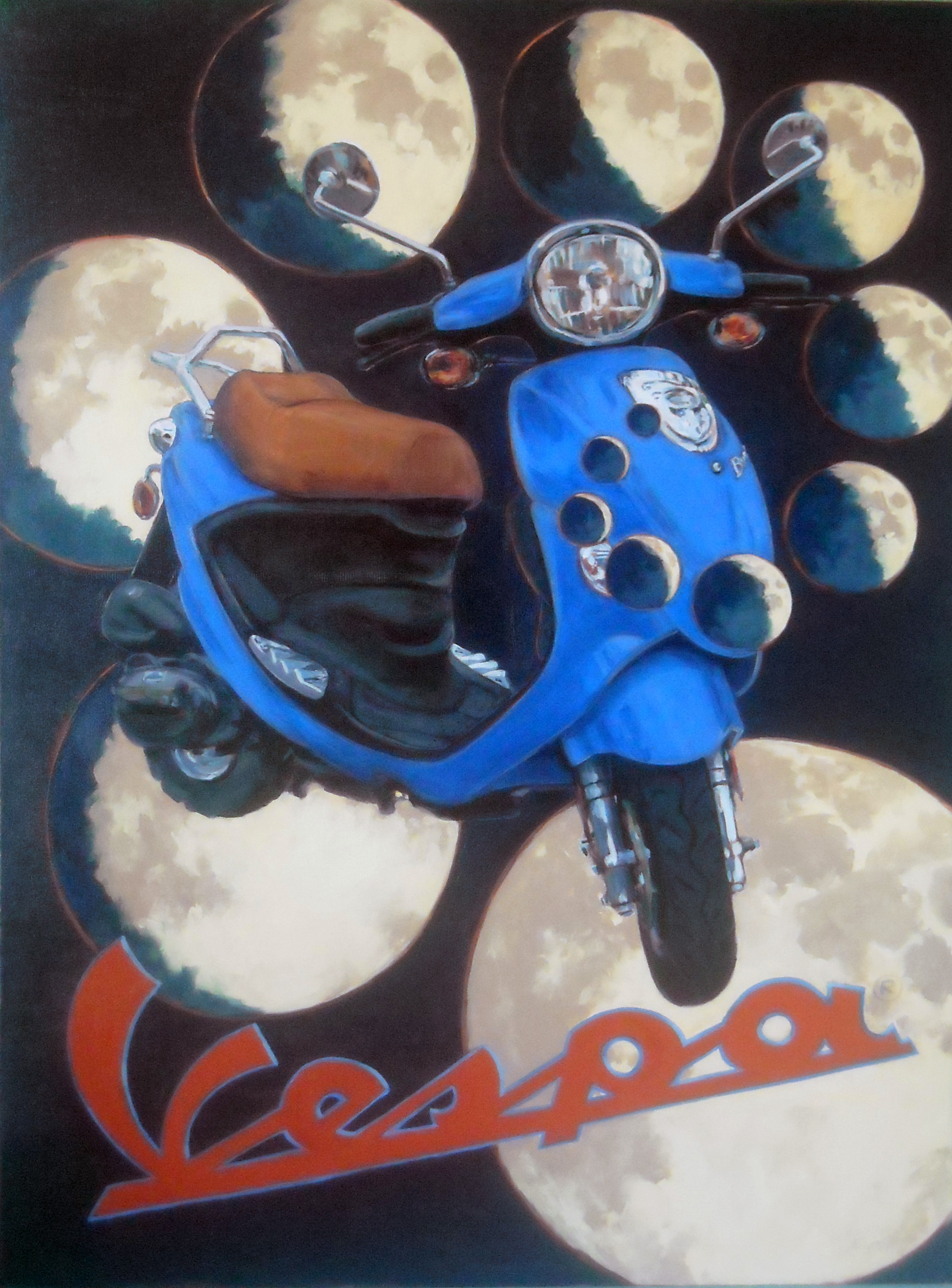 For a brand new scooter, the Vespa has had a few paint jobs. Here’s the final painting. I’m pleased.
I showed it in the Trolley Barn Artists Show at Art Factors in November 2011.
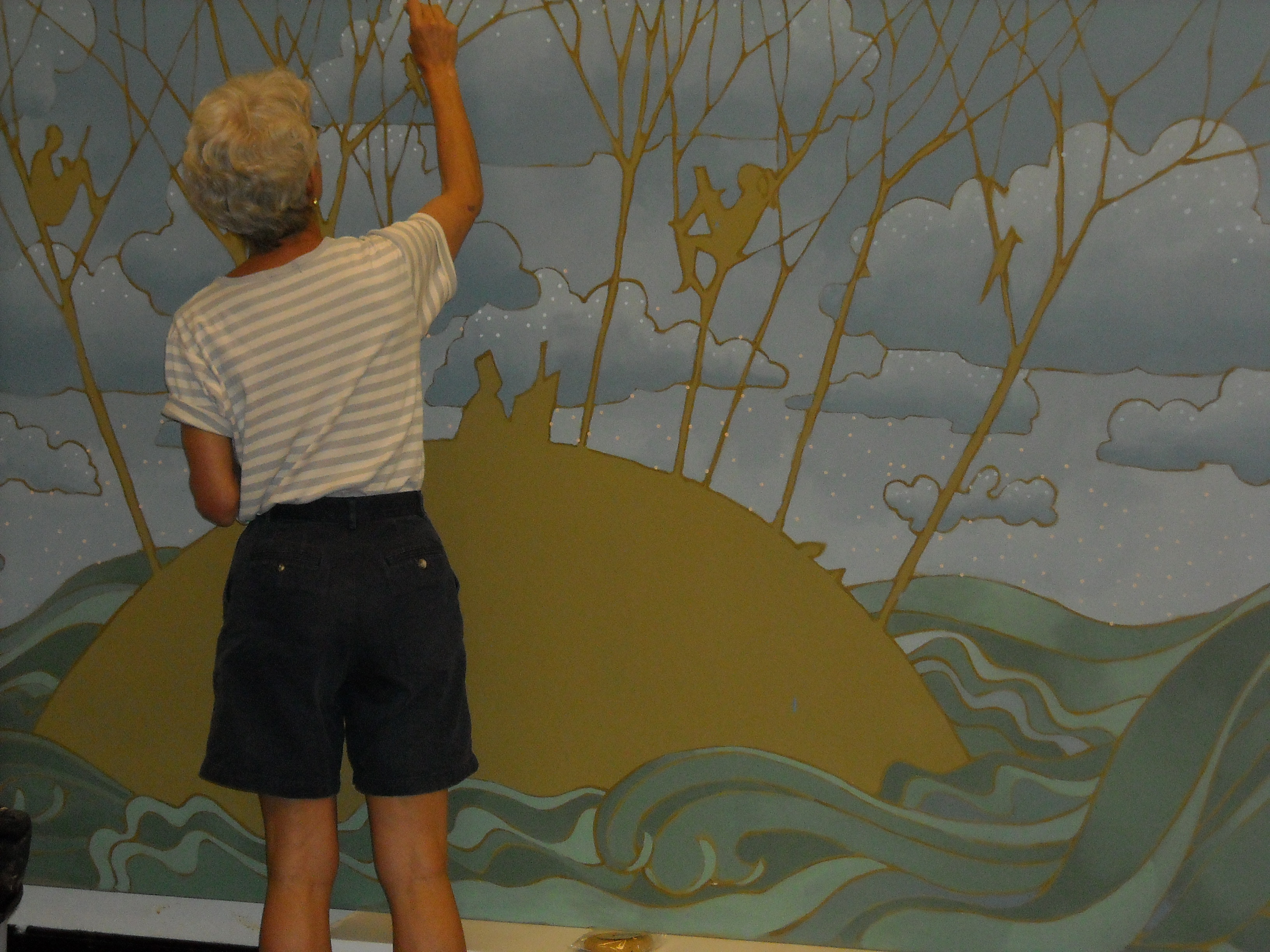 Video of the new and fabulously beautiful mural in the lobby of the Multnomah Arts Center.
http://www.multnomahartscenter.org/2011/04/07/mac-mural-project-documentry-is-now-online/
THE WATCHER
I am the reader, the listener, the watcher
Of others, on the sidelines, the waiter
Of something to happen, the observer,
The spectator, the student
Who soaks in the lecture
But does not raise my hand
To ask the question
That would illuminate and
Instead no one learns anything more.
I cannot play until I’ve finished
The chore. How surprised I am to find the moment gone.
I stay forever diminished.
by me 2009
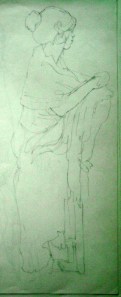 A few years ago, I took a class to draw the clothed figure. Our model Maja wore a long white gown and a red shawl and reminded us all of John Singer Sargent’s studies for and painting of “El Jaleo.”
This is one of several drawings of Maja from that modeling session. It’s about 4×12 inches and rather lightly penciled on white paper so it doesn’t reproduce all that well.
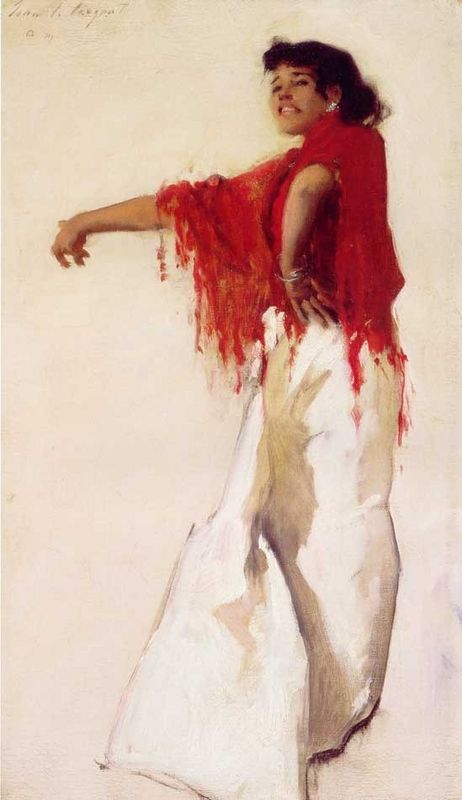 For this post, I’d looked for Sargent’s oil study of a flamenco dancer I had seen at the Boston Museum of Fine Arts. But then I came upon “The Spanish Gypsy Dancer.” Oh my. Sargent’s painting, even this tiny copy from the Internet, quite takes my breath away.
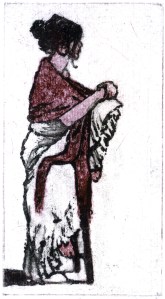 So what do you do with a drawing you rather like? Leave it hidden away in the sketchpad? Or…?
Almost right away, I knew I wanted to create an etching and call it “The Rose Shawl.” This is ink lift and aquatint on a copper plate approximately 2.5×5 inches. After applying the black ink, I rubbed in a bit of red for both the shawl and skin tone, then printed on white Murillo.
Three or four years after the original modeling session, as I gaze with astonishment at Sargent’s art, maybe I’ll be inspired to take my drawings of Maja into paintings.
 rightingmyleftbrain